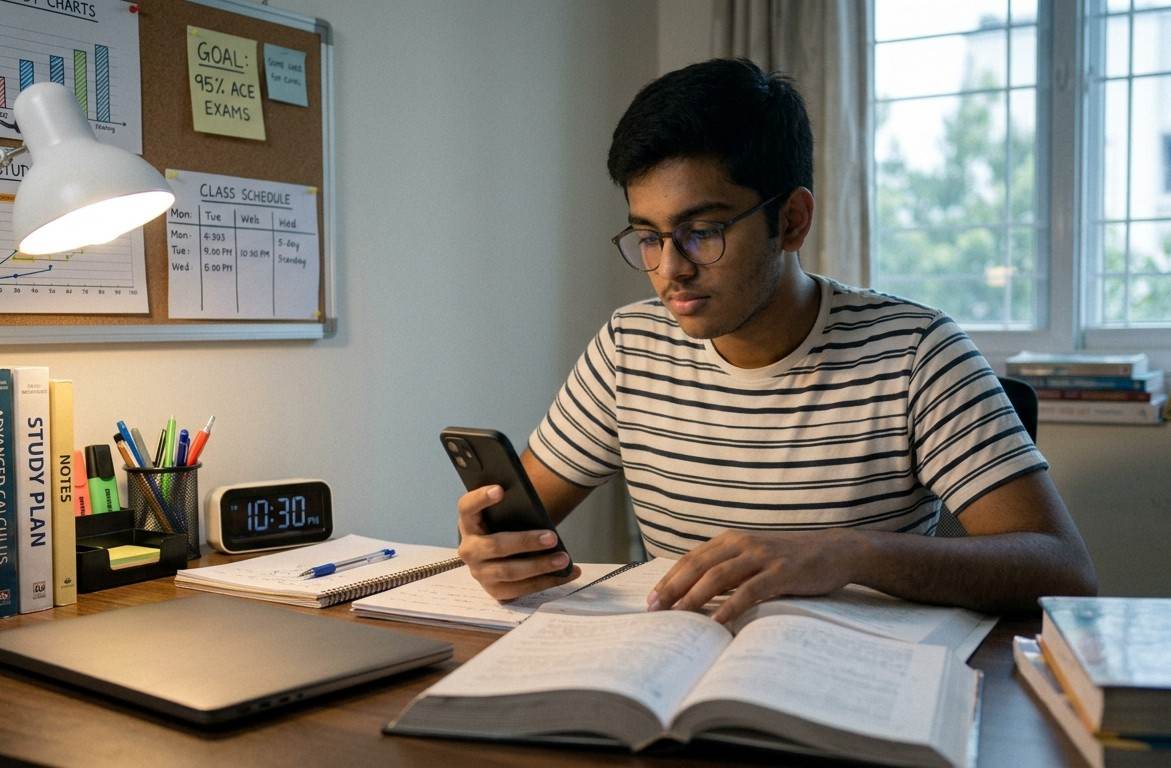
A student sits down to study for 20 minutes before a quick Instagram break. The plan is simple — check a few messages, watch one reel, then get back to the textbook. Forty-five minutes later, they’re still scrolling, the book is still open to the same page, and there’s a quiet, familiar feeling of “I’ll make up for this later.”
If this sounds familiar, you’re not alone — this happens to most students at some point, regardless of how disciplined they usually are. Social media isn’t going anywhere, and for PU and Class 10 students, it’s a normal part of daily life — for staying in touch with friends, following interests, and even learning new things.
The real question isn’t whether students should use social media. It’s whether they’re in control of how, when, and how much they use it — because that’s what actually determines whether it helps or hurts focus, motivation, and academic performance.
Before looking at the effects, it helps to look at how social media fits into a typical student’s routine, since it’s rarely just “wasting time.”
Social media serves real purposes in a student’s life. The issue isn’t the platform itself — it’s what happens when short, intentional use turns into long, unplanned scrolling.
Here’s where things start to get tricky, especially during exam preparation or long study sessions.
Social media platforms are designed to keep users engaged — that’s simply how they work. A single video or post often leads to another, and another, because the next piece of content is always right there. For a student trying to take a five-minute break, this design makes it easy to lose track of time without even realizing it.
Some students keep their phone next to them while studying, telling themselves they’ll only check it “if something important comes up.” But even the awareness of a phone being nearby can pull attention away from the task, making it harder to fully concentrate on a chapter or problem.
After a scrolling break, it often takes longer than expected to get back into a focused study mindset. The brain needs a moment to shift from quick, easy content to slower, effortful thinking — and this transition doesn’t happen instantly.
Social media doesn’t just interrupt studying — it can actively feed procrastination, especially when a subject feels difficult or boring.
This is a common and very human pattern — not a sign of laziness, but a natural response to avoiding something effortful in favour of something easy and immediately enjoyable.
Even without opening an app, notifications alone can break concentration.
Over a few hours of studying, these small interruptions add up, often without the student realizing how much total time and focus was actually lost.
Beyond focus, social media can quietly influence how motivated a student feels to study in the first place.
This doesn’t mean social media destroys motivation — but unmanaged use can make it harder to stay engaged with tasks that require sustained effort.
When social media use isn’t balanced, its effects often show up in a few common areas.
Frequent interruptions can lead to fragmented study sessions rather than focused, productive ones — a student might “study” for three hours but with so many breaks that actual learning time is much shorter.
Late-night scrolling is a common habit among PU students, especially before exams when stress is already high. This can lead to reduced sleep, which directly affects concentration and memory the next day.
The combined effect of reduced focus, delayed studying, and poor sleep can gradually impact exam preparation and performance — not through one single incident, but through small, repeated patterns over weeks or months.
It’s worth being fair here — social media isn’t only a distraction. Used well, it can genuinely support learning.
The difference lies entirely in intention — using social media to learn something specific is very different from opening an app out of habit and losing track of time.
Aspect | Healthy Use | Unhealthy Use |
Purpose | Used with a clear reason — learning, connecting, or a planned break | Used out of habit or boredom, without a specific reason |
Time awareness | Breaks are time-bound and tracked | Time is lost without noticing; “5 minutes” turns into an hour |
Impact on studies | Doesn’t interfere with planned study sessions | Frequently delays or interrupts studying |
Emotional effect | Neutral or positive; occasional connection or learning | Can lead to comparison, distraction, or restlessness |
Sleep | Phone use stops well before bedtime | Late-night scrolling reduces sleep quality and duration |
Control | Student decides when to start and stop | App and notifications decide when attention shifts |
This table isn’t about avoiding social media altogether — it’s about noticing which side of the table a daily routine tends to fall on, and adjusting accordingly.
Balance doesn’t mean quitting social media — it means using it in a way that doesn’t take over study time.
Example 1: A student plans to revise Biology for an hour but checks WhatsApp during a “quick pause.” A friend shares a funny video, leading to 40 minutes of unplanned scrolling. The original plan gets pushed to late at night, affecting both study quality and sleep.
Example 2: Another student uses YouTube specifically to understand a difficult Chemistry topic, watches a 10-minute explainer video, and returns to solving practice questions with better clarity. Same platform, very different outcome — because the use was intentional and time-bound.
These examples show that the platform itself isn’t the deciding factor — how it’s used within a study routine is what matters.
Parents and teachers can play a meaningful role here, without needing to control or restrict social media completely.
At Surana PU College, Peenya, faculty regularly encourage students to build practical study routines that work alongside their daily habits, including realistic approaches to managing phone and social media use — rather than expecting students to avoid it altogether.
It can, especially when it interrupts study time, reduces sleep, or leads to frequent procrastination — but the effect depends on how much and how it's used, not on using it at all.
Not necessarily. Most students can continue using it in a controlled, time-bound way rather than cutting it off completely, which can feel unsustainable.
Try keeping your phone in another room or on silent mode during study sessions, and use a timer to plan specific, limited breaks instead of checking impulsively.
No. It can support learning through educational content and help students stay connected, as long as usage stays intentional and doesn't interfere with study time or sleep.
Most platforms are designed to keep users engaged through continuous content, which makes it easy to lose track of time without realizing it.
Social media isn’t the enemy of good grades, and it doesn’t need to be eliminated to protect focus or motivation. The real difference lies in intention and control — using it for a specific purpose and a set amount of time, rather than letting it fill in every spare moment or interrupt study sessions unnoticed.
For PU and Class 10 students juggling academic pressure with a naturally connected digital life, the goal isn’t to choose between studying and social media. It’s to build enough awareness of personal habits to know when a quick break is genuinely a break — and when it’s quietly becoming something that affects focus, motivation, sleep, and ultimately, academic performance.
Copyright © 2025 Surana Independent PU College, Peenya. All Rights Reserved
 080-23370056/57

