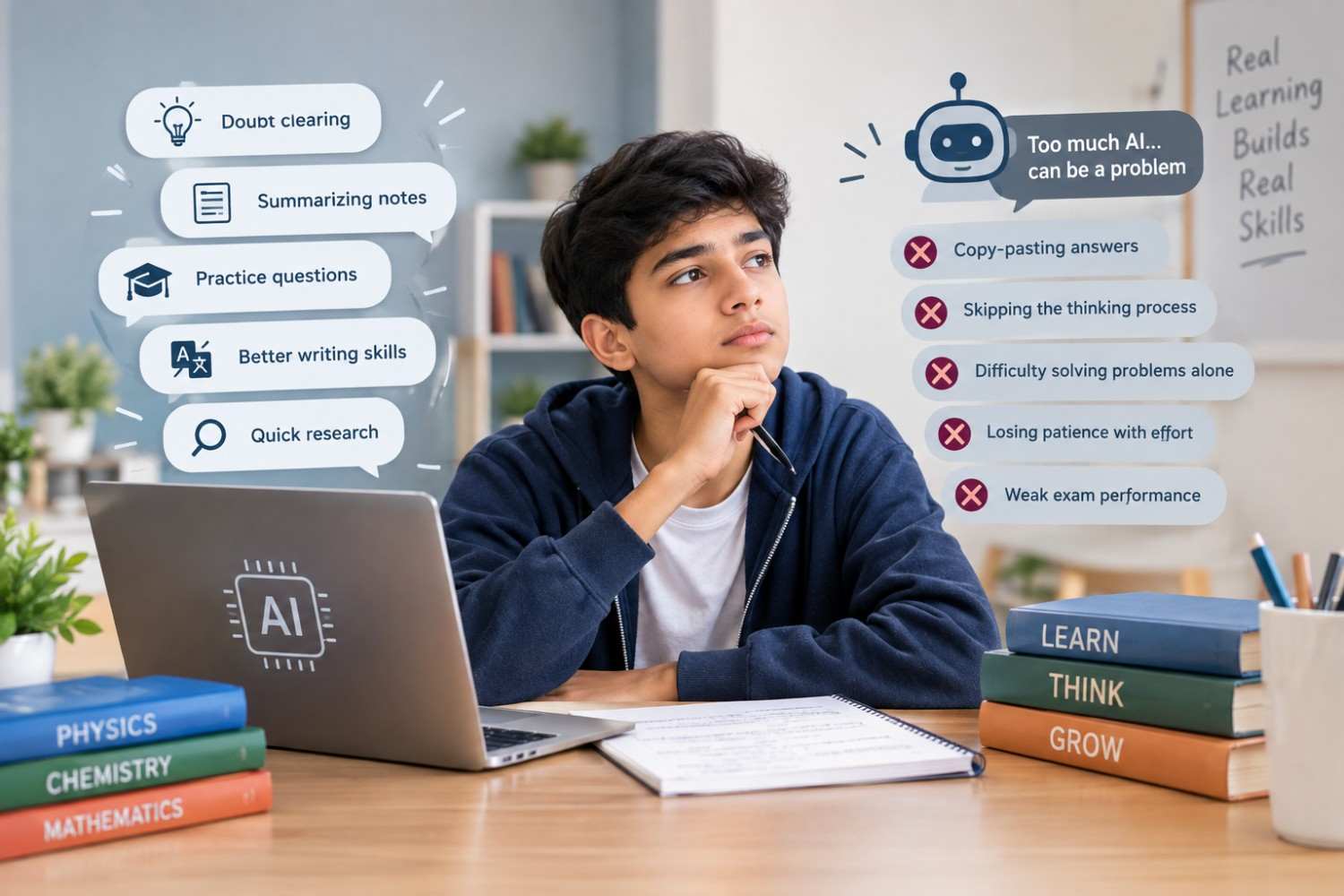
If you walk into any PU classroom today, chances are at least half the students have used an AI tool in the last 24 hours — to solve a physics problem, rewrite an essay, or just settle an argument about a general knowledge fact. AI has quietly become part of how students study, and there’s no going back to a world without it.
But this raises a real question that students, parents, and teachers at Surana PU College, Peenya, and everywhere else are asking: is AI actually helping students learn better, or is it just doing their thinking for them?
The honest answer is — it depends entirely on how it’s used. This blog looks at both sides clearly, without exaggeration, so students and parents can make sense of where AI helps and where it can quietly hurt.
AI for studying has moved far beyond just “asking Google a question.” Here’s how PU and Class 10 students typically use it in daily life:
None of this is inherently bad. In fact, used correctly, it can make studying more efficient. The problem starts when “help” turns into “replacement.”
Let’s start with what AI genuinely does well, because it’s not fair to only focus on the negatives.
Not every student has someone available at 10 PM to explain why a chemical equation isn’t balancing. AI tools can give a quick explanation on the spot, which is genuinely useful when a teacher or parent isn’t around.
A student struggling with trigonometry can ask the same question five different ways until it clicks — without feeling embarrassed about asking “too many questions” in class.
AI is good at turning messy notes into clean summaries, flashcards, or bullet-point revision sheets, saving time that can be used for actual practice instead.
Sometimes a textbook explanation doesn’t work for a student, but hearing the same concept explained differently by AI helps it make sense.
For students who find English writing difficult, AI can help them see how a sentence could be structured better — as long as they analyze why it’s better, not just copy it.
This is the part that worries teachers and parents the most, and rightly so.
Here’s a simple example. A PU student preparing for a Physics numerical asks AI to solve it. The AI gives the correct answer with steps. The student copies it down, feels satisfied, and moves to the next question — without actually solving a single problem independently. Exam day comes, and a slightly different version of that same question appears. The student freezes, because they never truly understood the method — they only saw it once.
This is the core danger: AI can show you the destination without you learning the route. And in exams, you need to know the route.
Independent thinking means being able to break down a problem, try an approach, fail, adjust, and eventually solve it yourself. AI, when misused, skips this entire process.
Aspect | Independent Thinking | Over-reliance on AI |
Problem-solving | Student tries multiple methods, learns from mistakes | Student expects a ready-made answer immediately |
Memory & retention | Concepts stick because of effort involved | Information is forgotten quickly since there’s no struggle |
Exam performance | Can adapt to new question patterns | Struggles when questions are slightly changed |
Confidence | Built gradually through practice | False confidence that fades under exam pressure |
Long-term skill | Strengthens analytical and reasoning ability | Weakens patience and problem-solving stamina |
Best use case | Learning core concepts, board exams, entrance tests | Quick clarification, not a replacement for practice |
This table isn’t meant to say AI is “bad” — it’s meant to show that AI and independent thinking serve different purposes, and one cannot fully replace the other, especially in a PU curriculum that still tests understanding through written exams.
Short answer: no, and it’s not close.
AI can explain a concept, but it cannot:
Teachers do far more than transfer information. They mentor, notice patterns over time, and adjust based on real interaction — something AI, no matter how advanced, cannot genuinely replicate. AI can be a support tool for teachers and students, but it works best alongside good teaching, not instead of it.
Here are practical habits that keep AI useful without letting it take over learning:
Colleges have an important role to play here — not by banning AI, but by teaching students how to use it wisely. This includes:
At Surana PU College, Peenya, the focus has always been on building strong conceptual understanding through classroom teaching, regular practice, and personal attention from faculty. Technology, including AI, is best treated as one more resource in a student’s toolkit — useful when balanced with genuine effort and guidance from teachers.
Yes, in moderation. AI is useful for doubt-clearing and quick revision, but it shouldn't replace regular practice and classroom learning.
It can help explain concepts and generate practice questions, but board exams test written, independent problem-solving, so hands-on practice is still essential.
It can, especially if you rely on AI-generated answers without understanding the reasoning behind them. Exams often test understanding, not memorized answers.
It depends on your college's policy. Many institutions expect original work, so it's best to use AI only for research or idea generation, not for writing the entire assignment.
Try solving problems yourself first, set a time limit for AI use, and regularly test yourself without any tools nearby.
AI isn’t the enemy of learning, and it isn’t a magic solution either. It’s a tool — and like any tool, its impact depends entirely on how it’s used. Used thoughtfully, AI can genuinely support PU and Class 10 students by clearing doubts, organizing study material, and making learning more efficient. Used carelessly, it can quietly erode the very skills — patience, reasoning, and independent problem-solving — that students need most, especially in board exams and beyond.
The goal isn’t to choose between AI and traditional learning. It’s to find a balance where AI supports effort instead of replacing it. Students who strike that balance, with guidance from parents and teachers, will find that AI genuinely does make them smarter — not because it gives them answers, but because it helps them ask better questions.
Copyright © 2025 Surana Independent PU College, Peenya. All Rights Reserved
 080-23370056/57

